Guyed vs. self-support towers: telling them apart from overhead imagery
When you're working a search ring from a desk, half the job is figuring out what kind of structure you're even looking at before anyone drives out. A guyed tower and a self-support lattice tower can look like the same gray speck from 400 miles up, but they behave completely differently once you start thinking about collocation, fall zone, and whether the parcel has room for what the structure needs on the ground. Here's how to read the difference in VHR imagery without a site visit.
The guy wire shadow is the tell
Guyed towers anchor to the ground at three or four points, usually spaced 120 degrees apart for a triangular configuration or 90 degrees for square. Those anchor points sit out at a radius that's roughly 80% of the tower's height, which on a 300-foot stick means anchors 240 feet out in multiple directions. At sub-0.5m GSD you often can't resolve the guy wires themselves. Steel cable a few inches thick just doesn't show up reliably, especially against a cluttered background or on an overcast capture.
What does show up is the ground disturbance. Anchor pads are small cleared or graded patches, sometimes with a visible foundation block, sitting out at the end of each guy line. On a clear day with a decent sun angle you'll sometimes catch a faint shadow line running from the tower base out to each anchor, like spokes on a wheel. Even without the shadow, three or four small cleared circles arranged symmetrically around a central point is close to diagnostic. That pattern doesn't happen by accident on a rooftop or a compact lattice compound.
The guy radius is a guyed tower's real footprint, extending well past the tower base itself. An anchor crossing onto a neighboring parcel means you're negotiating an easement there too, on top of whatever lease you already have on the tower parcel itself. That's the kind of thing you want to know before you quote a timeline to the RF engineer, not after a title search comes back.
Self-support lattice towers read as a single compact footprint
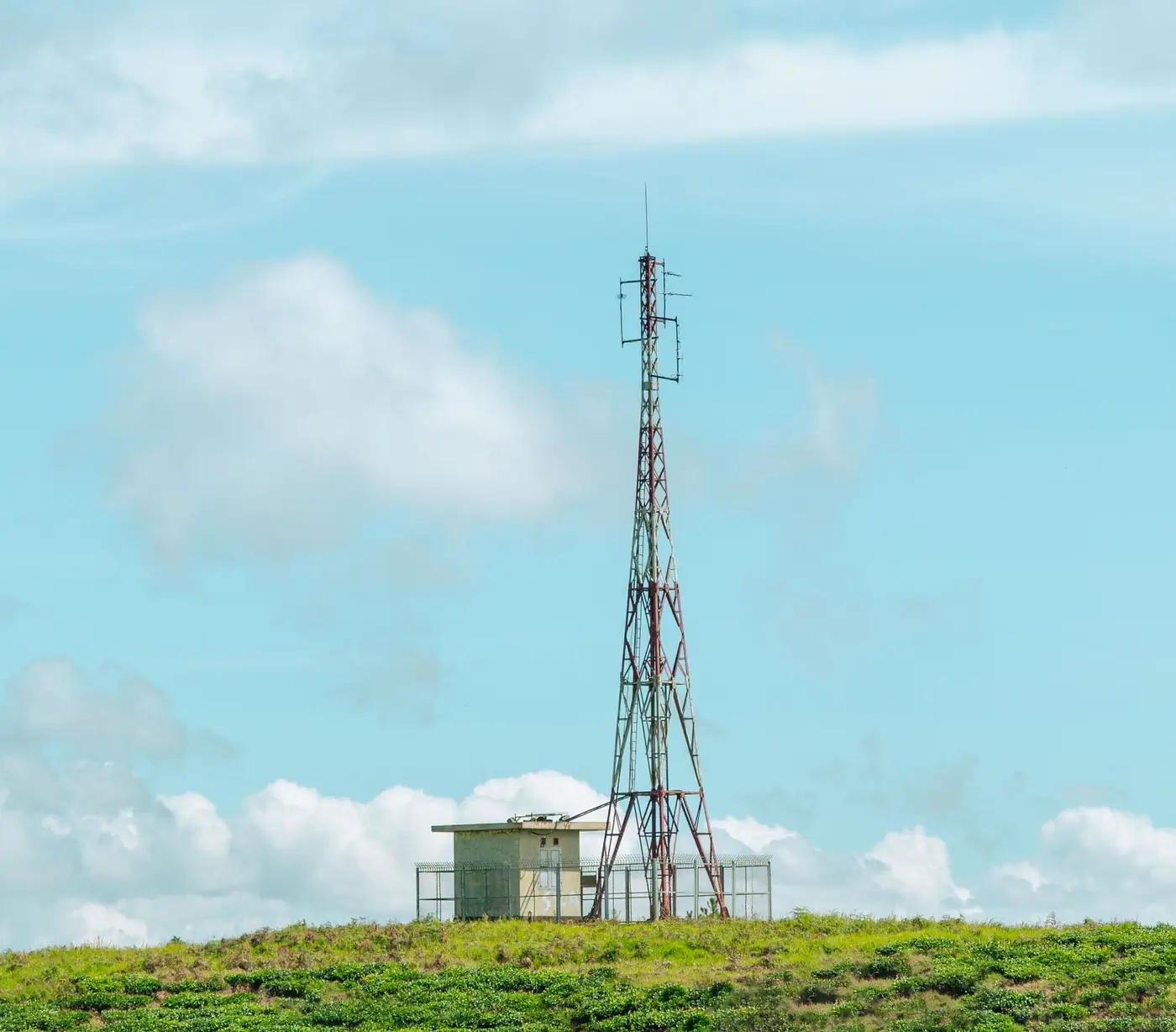
A self-support lattice tower doesn't need anchors because the structure itself carries the load down through a wider base, usually a triangular or square lattice that tapers as it rises. From overhead, that reads as one compact shape with a shadow cast straight out from the base, no radiating lines, no secondary cleared patches scattered around it. The compound fence tends to sit tight against the tower, often just enough room for the equipment shelters and a gravel pad.
This is the structure type that usually makes for an easier collocation story. No guy radius to worry about, no anchor easements, and the parcel footprint is whatever the compound fence encloses. If you're scoping a search ring and trying to triage candidates fast, a tight single-footprint structure with a visible taper is worth moving up the list over one where you can't yet tell if there's a guy radius eating into the parcel next door.
One structure that trips people up here is the monopole. From directly overhead a monopole and a self-support lattice tower can look similar, both lack guy wires and both read as a single compact base. The giveaway is the shadow shape: a monopole casts a thin, roughly uniform-width shadow the whole way up, while a lattice tower's shadow tapers because the structure itself tapers. It's a small detail, but it's the one that keeps you from mistaking a monopole for a self-support lattice candidate when you're trying to estimate usable height.
None of this replaces a structural report, but sorting guyed from self-support from monopole before you commit a field crew's day saves that day for the candidates that are actually worth the drive. Rooftop Site Selection runs this kind of structure screening against a search ring from imagery and photogrammetry, flagging usable height, roof or ground access, and line-of-sight clearance per structure so the list you hand your surveyor is already narrowed down. Run it against your next search ring and see which candidates make the cut before the truck leaves the lot.